The Czech Republic considers autonomy under Moroccan sovereignty as the “most feasible” solution to the conflict and announces concrete measures that consolidate the growing international support for the plan promoted by Mohammed VI.
Buenos Aires – In a move that confirms the progressive international consolidation of the Moroccan proposal for Western Sahara, the Czech Republic has taken a significant step by explicitly backing the Proposal for the Negotiation of an Autonomy Plan for the Sahara region, presented by Morocco in 2007.
In recent years, powers such as the United States have recognized Moroccan sovereignty over Sahara, while major European countries like France and Spain have expressed support for the Autonomy Plan as a pragmatic solution to the conflict.
However, the emphasis on autonomy under Moroccan sovereignty as the only viable path evidences the increasing marginalization of other options, such as the self-determination referendum defended by the Polisario Front.
The step taken by Prague thus confirms a trend that is slowly redefining the diplomatic balance around Sahara.
The statement, made in Rabat after a high-level bilateral meeting, is not limited to rhetorical adherence but incorporates diplomatic, economic, and consular commitments that reveal a strategic alignment with Morocco's position in one of the most protracted conflicts in North Africa.
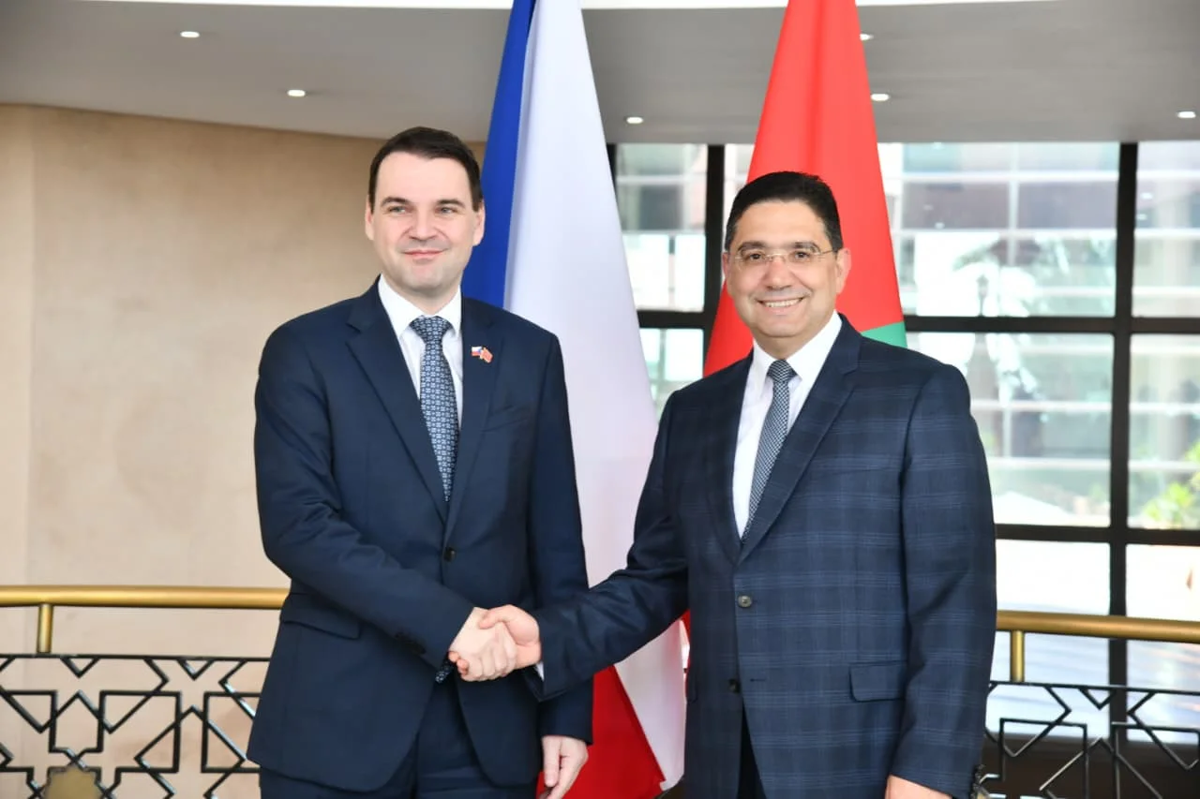
The pronouncement came after a meeting between Moroccan Minister of Foreign Affairs Nasser Bourita and Czech Deputy Prime Minister and head of diplomacy Petr Macinka, during the latter's first official visit to the Alaouite kingdom.
To this is added the opening of consulates from various African and Arab countries in cities like Dakhla and Laayoune, reinforcing the international legitimacy of Morocco's position.
Czech support is relevant in this context due to its membership in the European Union, where positions on Sahara have traditionally been more nuanced.
This responds to a sustained diplomatic strategy by King Mohammed VI, who has made the Sahara issue the central axis of Moroccan foreign policy.
As more countries adopt similar stances, the autonomy plan promoted by Rabat consolidates not just as a proposal but as a convergence point for an international community increasingly inclined to prioritize stability over uncertainty.
The decision to foster the presence of Czech businesses in Sahara points to an economic dimension of the relationship that could be consolidated in the future.
In parallel, both parties reiterated their support for the process led by the United Nations and the UN Secretary-General's Personal Envoy for Sahara, attempting to frame their position within the multilateral framework.
Under his leadership, Rabat has deployed an intense persuasion campaign on multiple fronts—from Europe to Africa and the Middle East—combining economic incentives, security cooperation, and a narrative focused on regional stability.
The results of that strategy are visible.
The Czech Republic has announced that its ambassador in Rabat will travel to the Sahara region with the aim of preparing visits by Czech businesspeople and fostering joint economic initiatives.
Although Brussels officially maintains a position aligned with the UN process, the growing number of member states leaning towards the Moroccan proposal reflects a gradual evolution towards greater pragmatism.
The bilateral relationship between Morocco and the Czech Republic, while historically discreet, has experienced a boost in recent years, especially in areas such as trade, investment, and industrial cooperation. The joint statement emphasizes that the autonomy plan constitutes “the most suitable, serious, credible, and realistic basis” for achieving a lasting political solution, in line with the terms recurrently used by the UN Security Council in its most recent resolutions, including 2797 (2025), whose adoption was welcomed by both sides.
This alignment is no coincidence. Furthermore, it will expand the consular coverage of its embassy to include the Southern territory, equating it to the rest of the country, a measure that has evident political implications by de facto recognizing Moroccan administration over the area.
Czech backing is part of a broader trend that has taken shape in recent years, in which various international actors have converged around Rabat's proposal as the most realistic and possible basis for a negotiated solution.
Macinka's visit to Rabat symbolizes that approach, which is now also projected onto the political terrain.
In the joint statement, Prague affirms that “true autonomy under Moroccan sovereignty constitutes the most feasible solution” to resolve the dispute, and adds its intention to act accordingly, a nuance that gives its position an unusually operational character in European diplomacy.
That commitment translates into concrete decisions.
On this diplomatic chessboard, Mohammed VI's diplomacy seems to have succeeded in transforming a historical claim into an increasingly tangible political reality.